
Supersonic!
Remembering a short-lived mixtape vending machine

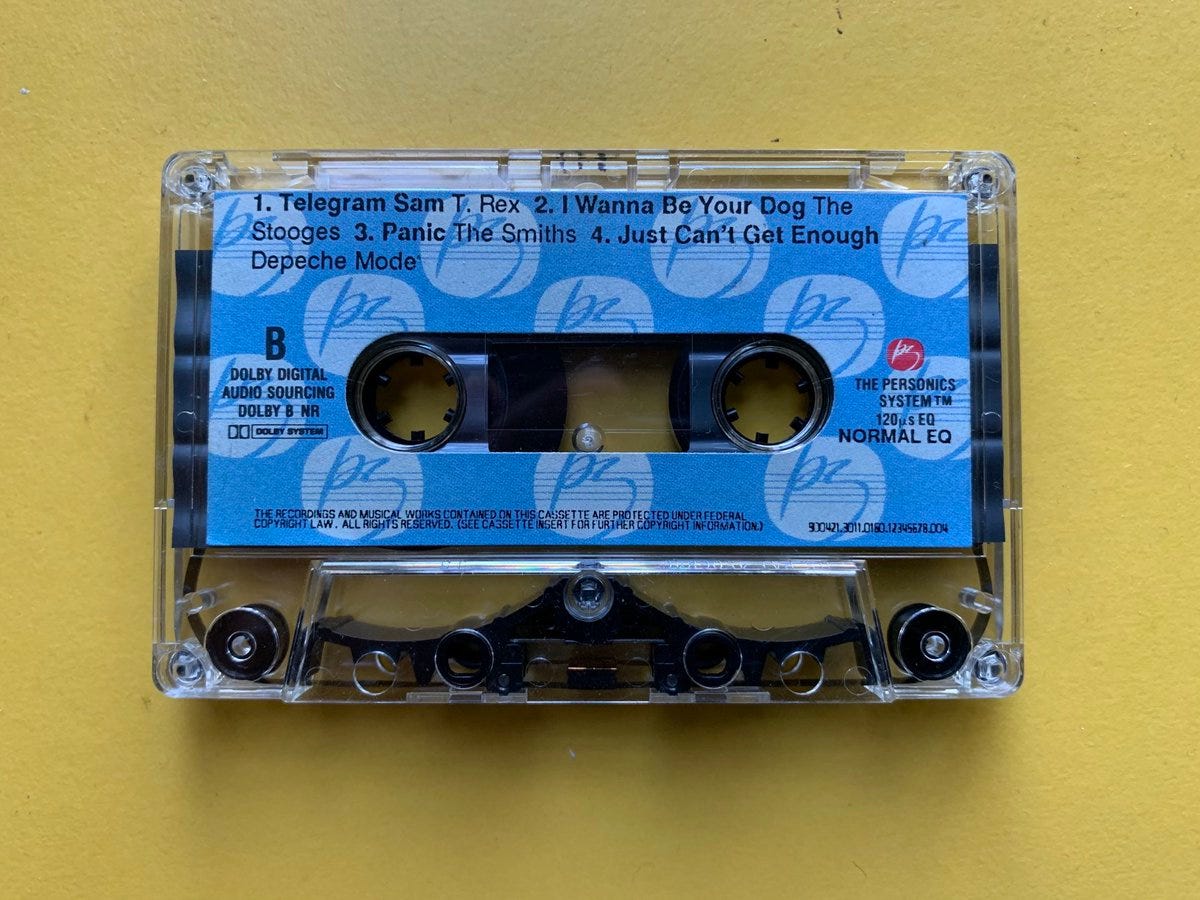
It was a good day of thrifting and yard sales Saturday, but my most intriguing find was an odd cassette I almost didn’t buy. It was labeled “Personics” and had a woman’s name, plus (presumably) her employer, printed on the sleeve. Inside the tape was a printed track listing of five custom songs, also printed on the aquamarine-and-lavender tape labels. A small logo on the cassette referred to “The Personics System.” Was this a really slick mixtape, something mail-ordered from far away, or something else?
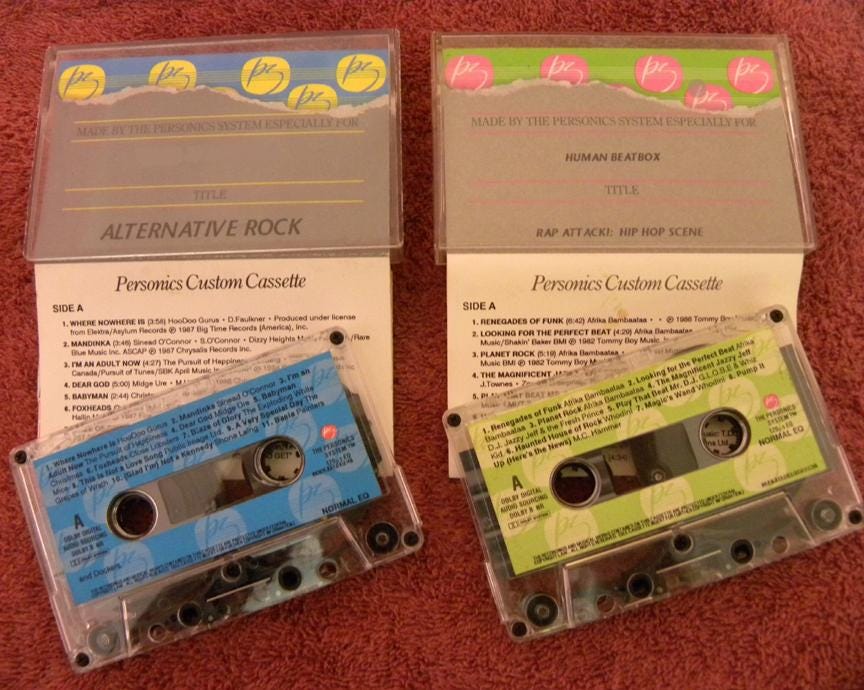
A quick Google search when I got home introduced me to the rise and fall of one Charles Garvin, who developed Personics in the mid-1980s as an ala carte music system to place in record stores. Combining two 60-disc jukebox changers and a customized Nakamichi tape deck, the system allowed users to select any song on the available CDs, arrange them in order on a tape, then wait a little bit to have it dub a high-quality copy at 8x speed and print a custom jacket.
Garvin got backing from major labels in the form of capital, but not in confidence – they got cold feet when it came to licensing their newest hits and most lucrative catalog to Personics, fearing it’d cannibalize record sales. These were the same people shitting their pants for years over “home taping,” estimating that the most low-tech form of music piracy to ever exist was costing them millions yearly, but they couldn’t get their heads around the convenience culture Garvin saw, where busy mallrats paid up for a mixtape made by a machine.
Personics was featured on Entertainment Tonight, rolled out more or less nationally, and boasted an installed base of about 200 units at its peak, along with a magazine that doubled as a printed catalog of the available songs that month. There’s precious little in the way of footage or photos of Personics at work, but one imagines a slightly more labor-intensive listening station, employees of Sam Goody or Wherehouse tasked with swapping out CDs monthly and helping new users navigate menus.
By 1991 the company was bankrupt. Without a critical mass of big hit songs to spur shoppers to opt for mixtapes, people just spent their money on the records, CDs and cassettes they came to buy in the first place. Dedicated home tapers and cheapskates were never gonna shell out money for a pro mixtape anyway, and casual fans needed a much easier and most robust onramp to abandon the current system – one they found a decade later with the advent of iTunes and Napster.
I, being one of those “we got tapes at home” people, as well as an early and enthusiastic fan of whole albums and deep cuts, was not the target demo for Personics. If I did pass one back then, I might have given it a passing glance on my way to eyeballing the few metal tapes Record Town had in stock, or (the opposite problem) despairing over the banquet of list-price obscurities Coconuts in Toledo always had. A mixtape machine just wasn’t for me.
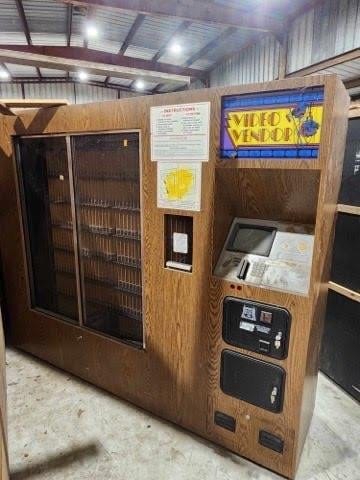
Now I’m more fascinated with the archaic system that made it work. I’m someone who seriously dreams of owning a Video Vendor, a walk-in-cooler-sized VHS tape rental vending machine run by a TRS-80 computer. If I had that and a working Personics system, I’d go into retail tomorrow and those would be the showpieces of my museum-slash-retro store.
And boy howdy, does the wistfulness in Garvin’s tone in the few interviews I’ve seen from him post-bankruptcy hit home! In the 2010s he told Pitchfork he’d moved on after realizing the major labels had him over a barrel and just weren’t going to change their minds. He closed up shop and got a job in investment banking, only to watch the music business implode and morph into a more tech-savvy version of his original dream. After all, what’s iTunes but Personics on proprietary hardware?
Listen. I’m the son of a man who tried for a decade to get his own motorcycle garage off the ground. I was selling software for defunct computers out of the classified ads in a rinky-dink newsprint magazine in 1991. My basement is a shrine to obsolescence, and my warehouse is packed to the gills with redundant media. Whatever the opposite of an early adopter is, that’s me – the guy insisting there’s still life left in a dead platform, the Monopoly player who still thinks he can turn the game around if he just avoids your Boardwalk and Park Place hotels the next seven or eight times around the block.
You show me an artifact from a doomed venture with a cool gadget involved, I’m gonna spike that whole origin story directly into my veins.
My life has been a series of instances of not getting the hint from an exasperated universe. We addressed this as a family in my current business before we expanded, which is why I’m forthcoming with the numbers and trying my best to suss out whether we’re gonna grow year-to-year or whether there’ll be a moment we call it and lock the doors.
When I go out to the warehouse, I never feel that feeling, at least not yet. I open the door and I think “this is cool as shit!” And I don’t know Charles Garvin personally, but I bet if he happened by at that moment, he’d reply “you’re damn right it is!” and we’d stand there looking at the thousands of spines before us – most from bands who thought they were cool as shit too, and had no idea how soon they’d be having their own going out of business sale.