
The Barometer Room
The 8-bit State of the Union

I’ve told the origin story of how I got into decrepit retro computers, buying a Texas Instruments machine with my paper route money years after it’d been discontinued, but I don’t think I ever shared what got me out of the hobby, or back into it.
In 1990, I’d just kitted out a full TI 99/4A setup with a printer, expansion box, disk drives, extra memory, and even a RAMdisk (sort of a half-assed version of a hard drive, without getting too in the weeds). Then I graduated from high school and one spring day, a distant relative from Florida mailed me a personal check for $10,000. She’d grown up in the Depression, never got to attend music school, so she was determined to give my generation a hand.
I could write a whole book about the hapless-lottery-winner debacle that followed giving a clueless impoverished 18-year-old access to ten large, but for the purposes of this story, know that I immediately bought myself a Commodore Amiga (the state of the art at the time) and took both systems to college with me that fall, to the consternation of the roommate sharing a very small dorm with me.
By the end of my sophomore year, the money was long gone, along with any hope of my staying in school. I put out feelers and wound up selling my whole TI rig to Bud Mills, a Toledo area TI guru and hardware vendor. He was practically cackling as he loaded up the system – this stuff was going for peanuts anyway, as PC and Mac became the dominant standards and before the internet galvanized the retro community. I’d offered my souped-up system at fire sale prices even by those standards, desperate to pay a phone bill or some other debt I no longer recall.
I kept picking up cheap gear – when my aorta dissected in 2004, my family had to move my stuff quickly into storage, and a whole shelf of questionable Commodore floppy drives wound up on the curb – but I gave up on having a working system to code on, much less any kind of game collection, until my family had assembled itself in a relatively stable home. I picked up another 99/4A system when we lived in a small apartment in Toledo’s Old West End, setting up an expansion box and a flickery monitor on the glassed-in back porch off the master bedroom.
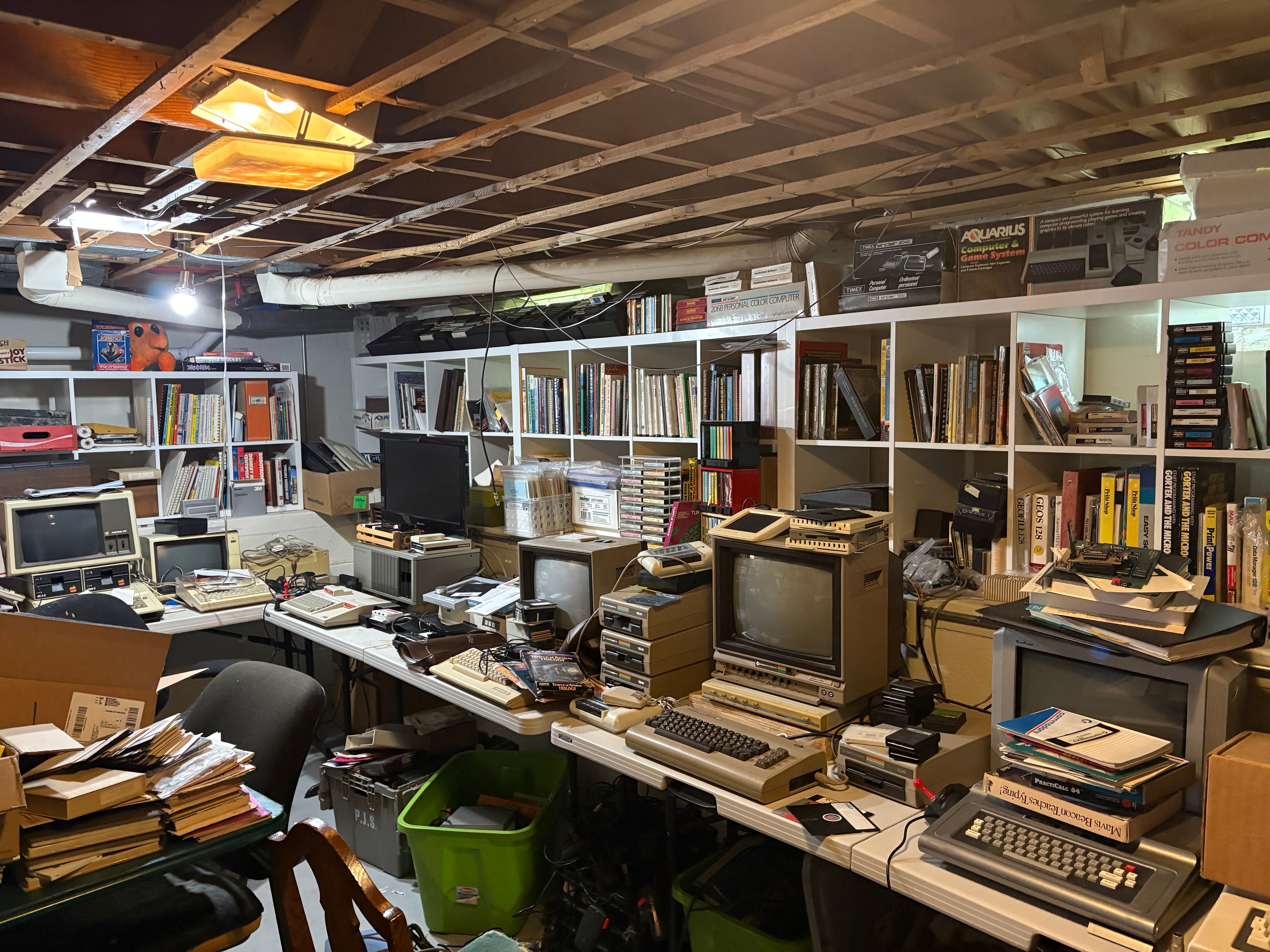
We landed in this house in 2009, and after some false starts, one half of the basement wound up designated as the War Room. It’s always been at least a little bit functional – a couple of my rigs set up on card tables, a few games accessible in a sea of boxes. I had a vision of a dozen computers, all ready to go at the touch of the on switch, all clean and working. I’d test stuff I planned to sell, write programs and convert them to run on multiple systems, I’d do deep dives into games I played in bits and pieces at friends’ houses as a kid.
The room’s always been a reflection of our lives in the moment. The 2010s were a blur of raising kids, navigating my daughter’s complex disabilites, attempting to fly in the face of common sense by starting a comedy career in my 40s, and hanging on to our lower middle-class privilege by our fingernails.
I’d find deals, haul them home, pile them next to the other ones, and swear I was gonna spend more time down there soon and get it all just right. Meanwhile, stacks of boxes teetered and pet projects I’d been excited to start were completely forgotten in the clutter.
The pandemic kept me home and spurred me to get to work. We put in shelving, hired my friend Kevin (is there anything that guy can’t do?) to run dedicated electrical and add 36 new outlets, and I started cataloging what I had in earnest, gradually carving out one corner, then another, and finally a more or less completely working space.
I used to bring Brady downstairs with me when I had a clear enough path to wrangle her wheelchair down the stairs and next to whatever computer I was messing with that day, and we’d sit there like kids in a treehouse, me with my usual steady patter of nonsense to keep her amused. When she passed away, I hid down there sometimes, taking solace in all this junk I’d bought as a repudiation of a hard childhood, ignoring the world that had been so unfair to my little girl.
Last fall the basement flooded just as we were committing to moving the business into a warehouse, when I already hadn’t had much time to spend down there, when things had gotten a little disorganized again. I didn’t lose anything this time, and my music collection was already safely on the ground floor, but cleaning up basement water and trying to air the smell out of the room was a poke in the eye to this newfound motivation I’d been feeling.
I’d already made plans to do a deep clean this week, then I picked up my Channel F a few days ago and got excited all over again for my retro hobby. And if that wasn’t enough, my buddy Jeff reached out to ask if I owned the Colecovision “Expansion Unit 3” and hinted that he might have one available.
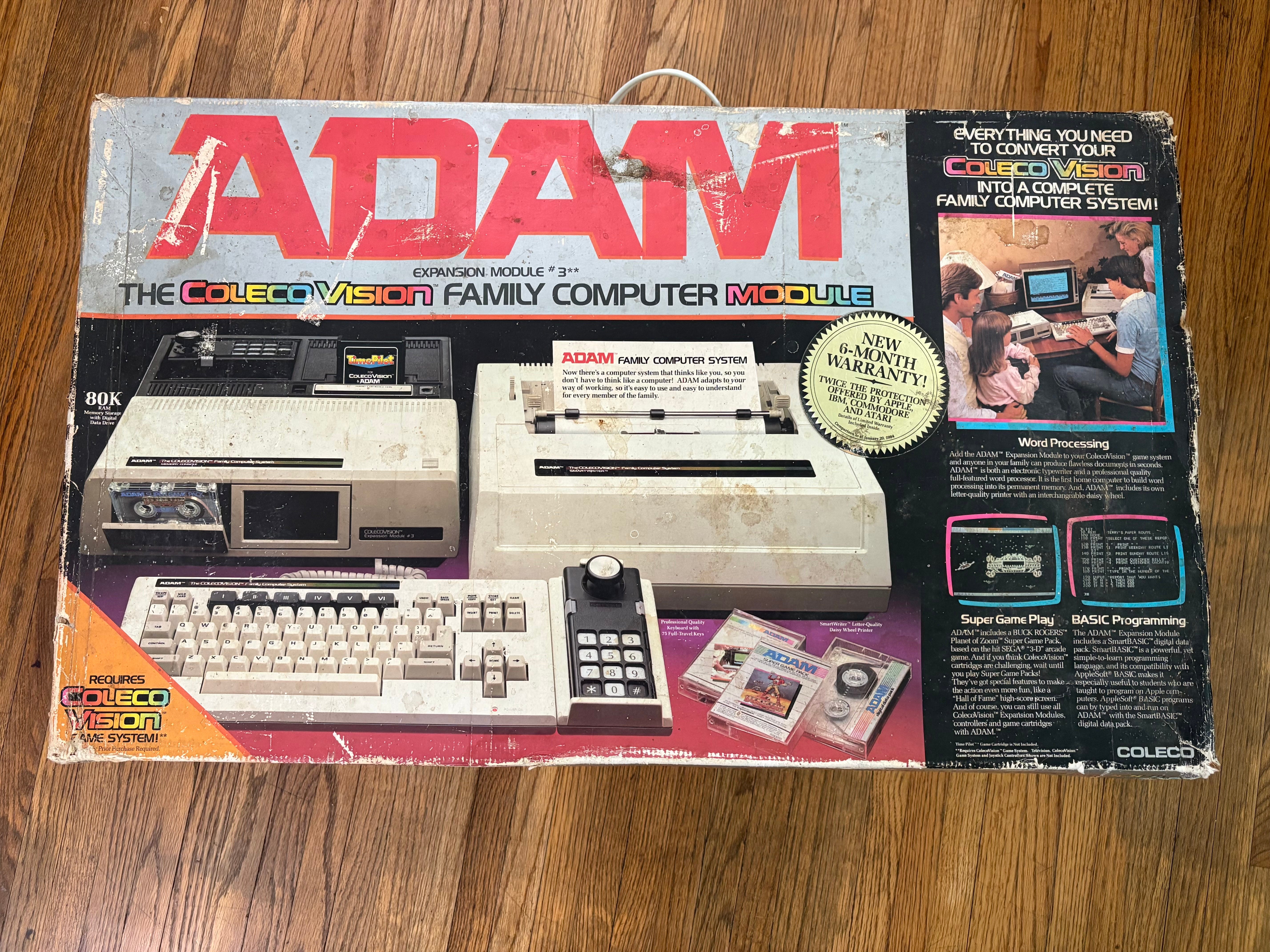
Short version: the Colecovision was a game console that kicked the Atari 2600’s ass to the moon, but never beat its massive sales. Just as the video game and computer market went into a tailspin, Coleco debuted the Adam – a computer you could buy as a freestanding unit, or as the aforementioned expansion module to plug into a Colecovision system.
The computer came with a printer (in fact, the power supply was hardwired to it so you couldn’t not use it), it used a proprietary tape drive, and it was legendary for parts failure and stock shortages. Within eighteen months it was discontinued, with surplus systems showing up in liquidation catalogs and stores like Big Lots. Coleco, the company, was bankrupt a couple years later.
Of course, like all ill-advised retro tech, the Adam has a cult following now, with a thriving homebrew and development scene. Working Adams fetch a pretty penny, and I’ve missed out on a few over the years. I wasn’t really even looking for one at the moment, having run out of space for more systems in the War Room, so Jeff’s offer took me by surprise.
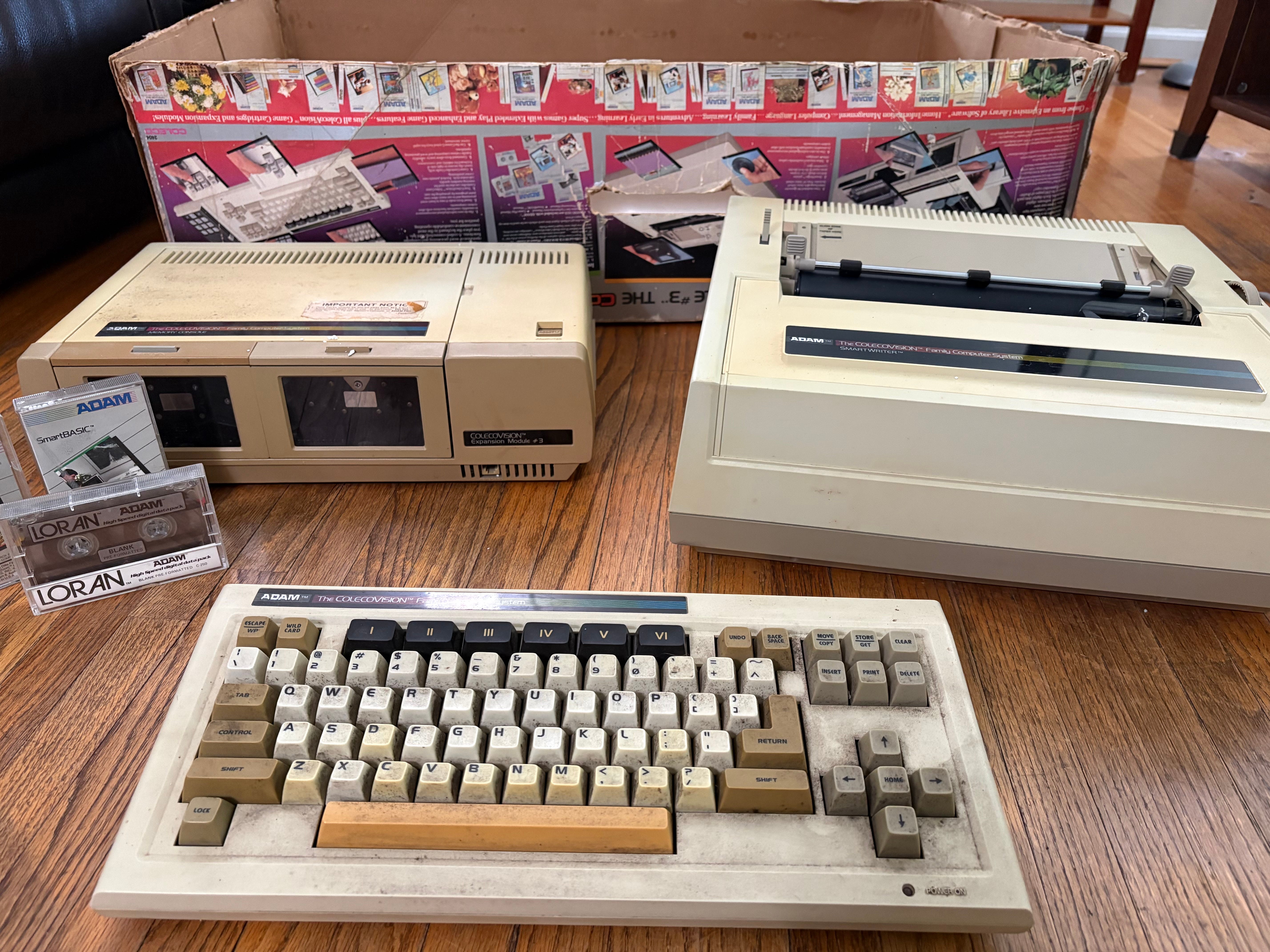
I was floored when he told me he was coming to the Detroit record show and that he was giving me the Expansion Unit 3 for free. He’d picked it up dirt cheap at an auction a good while back, never even took it out of the box, and decided its destiny lay elsewhere and he’d know where it needed to go when the time came. We met up in the morning hours and he handed it off, and I wedged the massive unwieldy box into the last of the empty space in the van when we loaded up our inventory to go home.
Not long ago, while cleaning up from the latest mess, I emptied a mail tub that had turned into a catch-all of manuals, cartridges, joysticks and miscellanea. At the bottom I found a bag from one of the Cleveland-area Record Exchange stores, containing a dozen or so Sega Genesis carts I’d bought for a dollar each. The receipt was still in the bag… dated 2010.
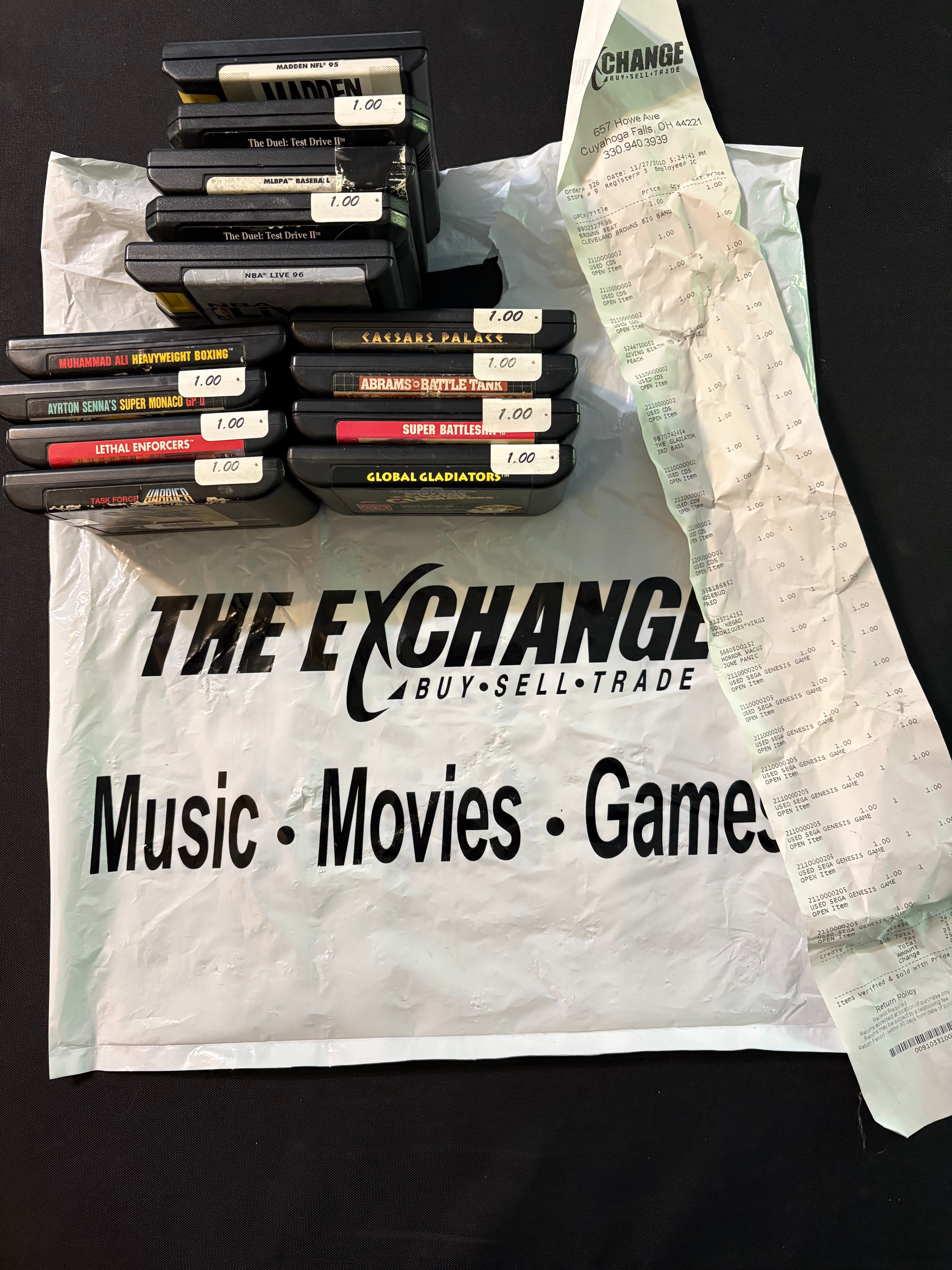
In some ways my lost decade of stacking and shuffling in the War Room was an accidental win. I’ve only looked up two of those cartridges so far, and both of them are going for $30 or more now. The days when I could drive up to Flint or Taylor and load up some old codger’s lifetime Commodore 64 collection for $150 are over for good. If I’d meant to salt away unappreciated treasures for a payday later in life, this would look like strategy, not hoarding.
But stashing stuff in a box and letting it sit on the basement floor for almost a third of my life is not a great look in any circumstance. I owe it to the generosity and kindness of my friend to get this Adam up and running, get to work on my various projects, and pay the good vibes forward in the form of contributing to the retro communities I enjoy from afar. I was playing games on my Channel F within a day of buying it, and I’ve pledged that I’ll make room to set up and test the Adam by the weekend.
First I gotta bleach and mop the floor, do some more straightening out, and protect the gains I’ve made down there. If I’m gonna have this ludicrous collection of obsolete beep and boop boxes in my life, I owe it to myself to make the whole experience something to enjoy and take pride in, not a pile of gently decomposing clutter and a source of anxiety and guilt.
Other old people have their garden or garage; my place to escape the world and putter just happens to look like the layaway room of a Montgomery Ward in 1983.
I for one wouldn't complain if you went into the weeds about RAM disks. My familiarity today with Microsoft architecture, so stubbornly set that it hinders me from learning shit like Linux, starts with my dad showing me how to set up a RAM disk in DOS forty years ago. We had an 8086 IBM compatible, and before getting a hard drive a RAM disk was the fast way to switch between several games that came on one floppy.